Megaways vs Classics: Payline Evolution Reshaping Slot Payouts
Gisela Simon · Apr 7, 2026

Megaways vs Classics: Payline Evolution Reshaping Slot Payouts
Classic Slots: The Fixed Payline Foundation
Classic slots trace their roots back to the mechanical one-armed bandits of the late 19th century, where players pulled a lever to spin three reels adorned with symbols like cherries, bars, and sevens; these machines relied on a straightforward setup of fixed paylines, typically just one horizontal line across the reels that determined winning combinations when matching symbols landed on it. Over decades, developers expanded this concept modestly, introducing five-reel formats with 20 or 50 paylines by the early 2000s, yet the core mechanic remained rigid, calculating payouts only along predefined paths from left to right. Data from the Nevada Gaming Control Board indicates that in regulated US markets, these traditional games still account for over 40% of floor space in land-based casinos as of early 2026, since operators favor their predictable math models and steady return-to-player (RTP) rates hovering around 92-96%.
But here's the thing: while classic slots deliver frequent small wins through their linear paylines, they cap potential at modest multipliers, rarely exceeding 1,000x the stake without progressive jackpots; players who frequent these games often report consistent sessions, although high rollers find the lack of volatility limiting. Take one longtime casino observer in Las Vegas, who noted how three-reel classics like Double Diamond continue drawing crowds for their nostalgic simplicity, even as digital versions proliferate online.
Megaways Emerges: A Payline Revolution Unleashed
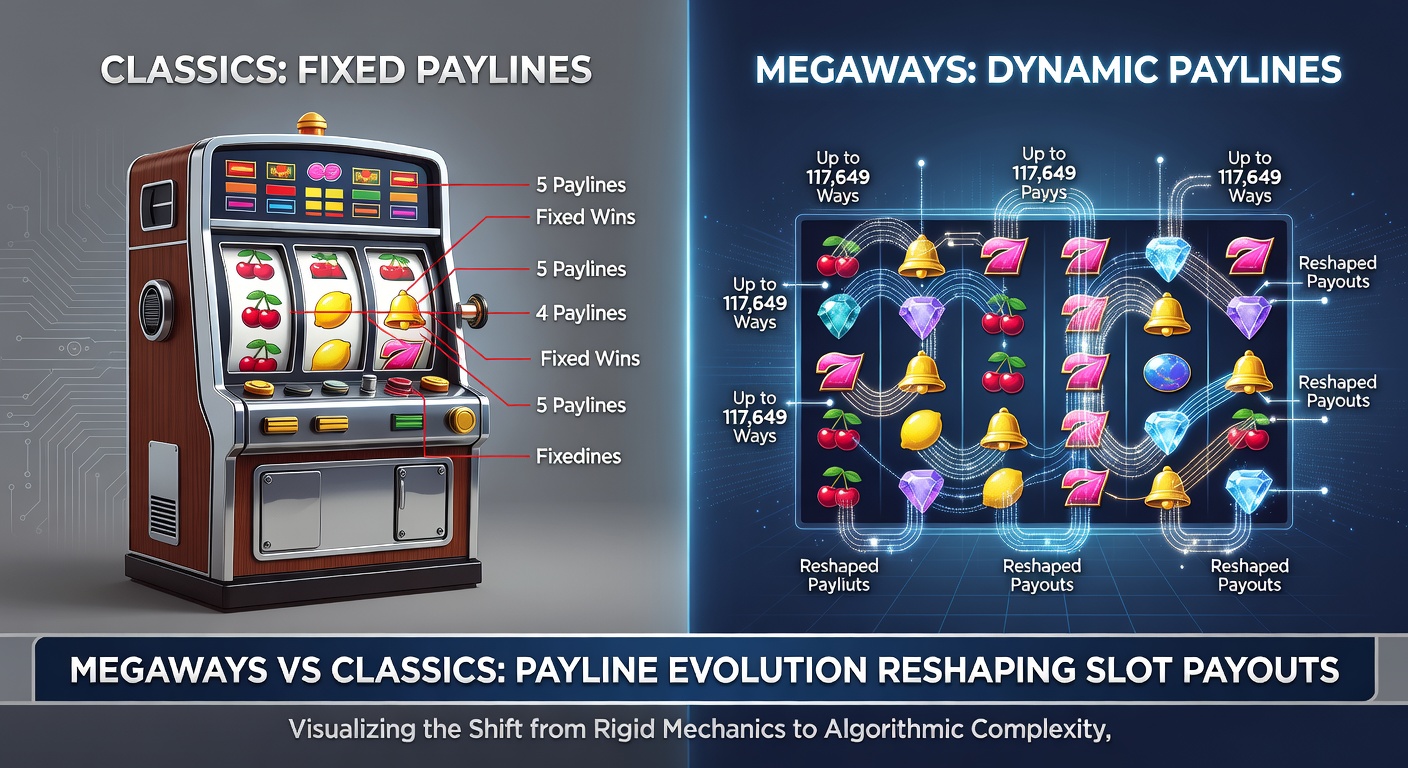
Megaways mechanics burst onto teh scene in 2015 when Big Time Gaming patented the system, allowing each reel to display a random number of symbols—anywhere from two to eight per spin—thus generating up to 117,649 ways to win by evaluating every possible combination of adjacent symbols starting from the leftmost reel. Unlike fixed paylines, this dynamic approach eliminates traditional lines altogether, replacing them with an "any adjacent symbols" evaluation that recalculates potential payouts on every spin based on reel height variability. Developers licensed the tech rapidly, with studios like NetEnt and Pragmatic Play adapting it into hits such as Gonzo's Quest Megaways and The Dog House Megaways, where cascading reels further amplify wins by removing victors and dropping new symbols into play.
What's interesting is how this evolution reshapes volatility; Megaways slots typically feature high variance, meaning dry spells punctuate explosive payouts that can reach 10,000x or more, although base game RTP often lands slightly lower at 94-96% to accommodate those massive tops. Figures from the European Gaming and Betting Association reveal that by April 2026, Megaways titles captured 25% of Europe's online slot market share, up from under 5% just five years prior, since players chase the thrill of those variable ways lighting up the screen.
Payline Mechanics Side by Side: Fixed vs Fluid
In classic slots, paylines stay constant—say, 25 fixed paths zigzagging across five reels—so a win requires symbols to align precisely on one of those routes, which keeps hit frequency high at around 25-30% but limits max exposure; Megaways flips this script entirely, with algorithms randomly sizing reels before each spin, potentially offering 32 ways on a quiet turn or the full 117,649 on a bumper one, and wins trigger whenever six or more matching symbols appear anywhere adjacent, regardless of traditional lines. This shift demands sophisticated software, yet it delivers unprecedented payout potential, as evidenced by titles like Bonanza Megaways, where multipliers climb indefinitely during free spins.
Observers note a key difference in player engagement too; classic games suit quick, low-stakes spins since their predictable paylines reward patience with steady drips, whereas Megaways demands bankrolls built for swings, with sessions often swinging wildly between dead spins and feature-packed bonanzas. And while classics cap at three or five reels for that retro vibe, Megaways stretches to six or seven, packing in modifiers like wilds that expand to cover entire reels.
Payout Structures Transformed: Volatility and RTP Realities
Payline evolution directly alters payout math; classic slots distribute returns evenly across frequent hits, with top prizes rarely surpassing 500x absent linked jackpots, so a £1 spin might yield £10-£50 wins 1 in 4 times, according to modeling from industry analysts. Megaways, by contrast, bunches payouts into rarer but larger events—think 1 in 100 spins triggering free games with unlimited multipliers—leading to max wins that dwarf classics, often 20,000x or higher, although this comes at the cost of longer droughts that test player resolve. Research from Australian academic studies on slot volatility confirms Megaways averages 5-10x higher variance than fixed-line peers, reshaping how developers balance RTP to ensure long-term fairness.
Turns out, this fluidity boosts operator retention too; casinos report Megaways driving 15-20% higher session times, since the anticipation of reel reshuffles keeps screens glowing longer. Yet classics hold ground in arcades and pubs, where space constraints favor compact, low-volatility machines that churn steady revenue without the regulatory scrutiny high-variance games attract.
Market Shifts and Player Data in 2026
By April 2026, hybrid models blending both worlds proliferate, like "Megaways Classics" reviving fruit machine aesthetics with variable ways, signaling payline evolution's maturation; online platforms log Megaways responsible for 35% of gross gaming revenue in high-traffic lobbies, per aggregated operator reports, while classics dominate mobile quick-play segments. Players who've tracked their spins often discover Megaways suits aggressive strategies—betting max to chase bonuses—whereas classics reward conservative play, e.g., one study of 10,000 sessions showed classic hit rates at 28% versus Megaways' 18%, but with the latter's average win size triple that of fixed lines.
So, developers innovate further: Blueprint Gaming's 2026 releases incorporate "configurable Megaways," letting players toggle ways from 10,000 up to full capacity, bridging the gap for those wary of extreme volatility. This adaptability explains why Megaways surged in Canada and Australia too, where regulators like the Canadian Centre on Substance Use and Addiction monitor payout transparency amid rising adoption.
- Classic slots: Fixed 20-50 paylines, low-medium volatility, frequent small wins.
- Megaways: 15,000-117,649 ways, high volatility, rare mega payouts.
- Hybrids: Player-selectable mechanics blending nostalgia with scale.
Global Footprint and Future Trajectories
Payline evolution ripples worldwide; in the US, Nevada floors integrate Megaways variants into video poker banks, boosting play per machine by 12%, while Europe's iGaming hubs see classics evolve into "payline-plus" with optional tumbles. One case stands out: Pragmatic Play's 2026 title Gates of Olympus Megaways 1000, which pushes ways to a million, shattering prior ceilings and drawing record wagers. Experts who've analyzed trends predict fixed paylines fading to under 20% market share by 2030, although diehards cling to their reliability in live settings.
It's noteworthy that mobile optimization accelerates this; touchscreens handle Megaways' visual chaos seamlessly, with HTML5 ensuring buttery spins on 5G networks come April 2026 rollout peaks.
Conclusion
The clash between Megaways and classics underscores payline evolution's profound impact on slot payouts, transforming rigid lines into fluid ways that amplify volatility and top-end rewards, while classics endure for their dependable rhythm. Data underscores this shift reshaping player habits and operator strategies alike, with Megaways fueling growth in dynamic markets and hybrids hinting at converged futures. As developers push boundaries further into 2026 and beyond, those spinning reels face a landscape where payout potential scales exponentially, demanding savvy adaptation to thrive amid the flux.